China Train Travel Tips: Food, Boarding & Practical Guide for Foreigners (2026)
Practical Tips Every Foreign Traveler Should Know
Navigating China's train system as a foreigner can feel overwhelming at first. This guide covers everything beyond seat selection — from choosing the right class for your trip, to ordering restaurant food at your seat, to boarding the train with a foreign passport.
How to Choose: Your Decision Framework
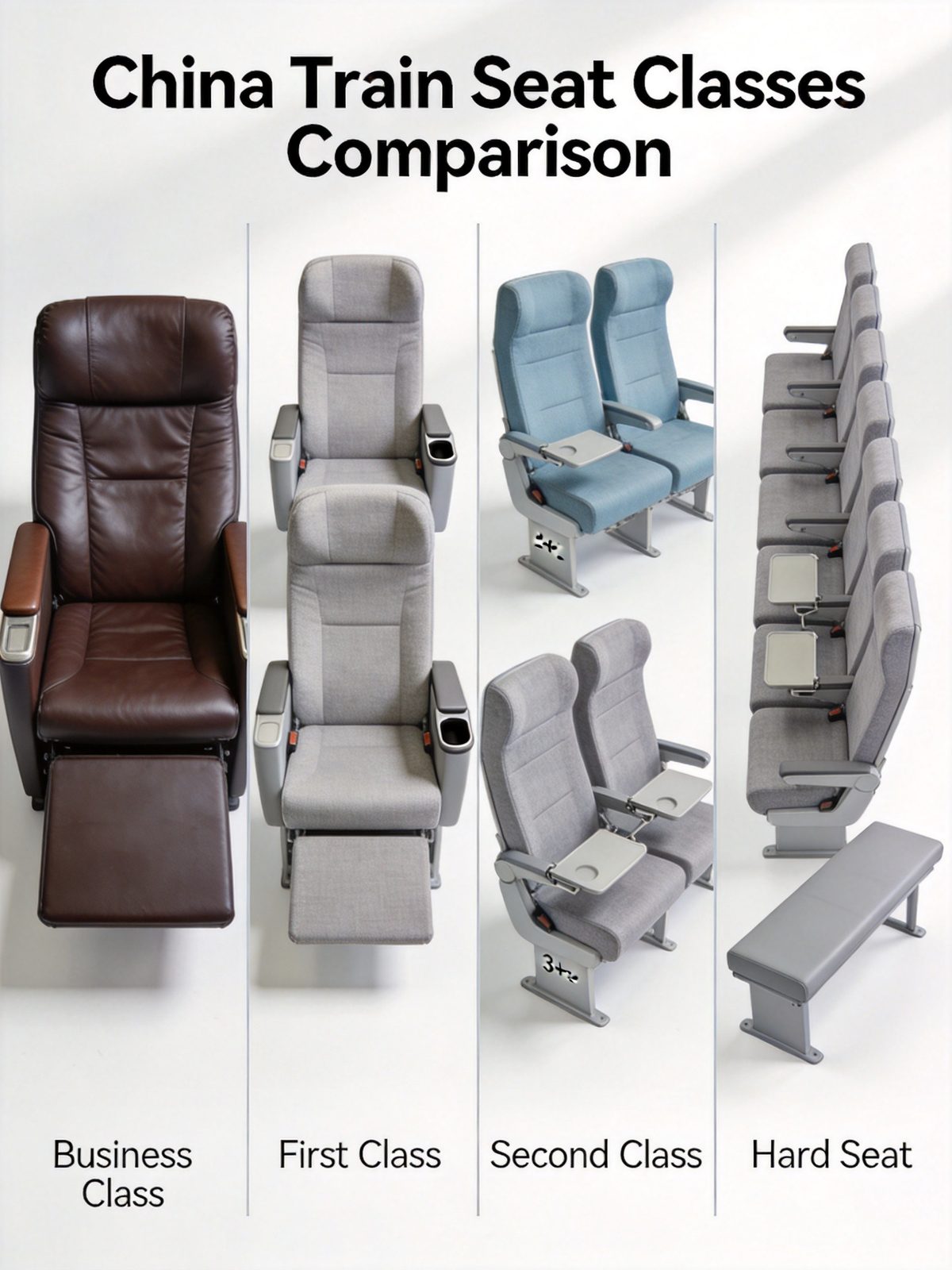 Quick comparison of all seat types
By Journey Length
| Trip Length | Best Choice | Why |
|---|
By Budget
| Class | Approx. Price (1000km) | vs. Second Class |
|---|
Comfort vs. Value: The Sweet Spot
Second Class is the workhorse — for anything under 4 hours, it's all you need. First Class is the best value upgrade — the difference is tangible but the price isn't insane. For journeys of 4–8 hours, it's usually worth it. Business Class is only worth it for overnight routes, business trips where you need to arrive fresh, or special occasions.
Budget Hack: Mix and Match
- Daytime short hops: Second Class (fine and cheap)
- Long daytime rides: First Class (worth the upgrade)
- Overnight long-distance: Hard Sleeper (saves a hotel night)
- One special route: Business Class (treat yourself once)
Food & Dining on China Trains
Onboard Food: The Basics
Every high-speed train has a dining car and attendants pushing food trolleys. Boxed meals (盒饭, héfàn) cost ¥30–80 — functional rather than delicious. Trolley snacks include bottled water (¥3–8), soft drinks, instant noodles, and packaged snacks.
First Class passengers get a small snack box and bottled water on long-distance G-trains. Business Class passengers get free hot meals plus unlimited snacks and drinks.
The 12306 Food Delivery Hack (高铁外卖)
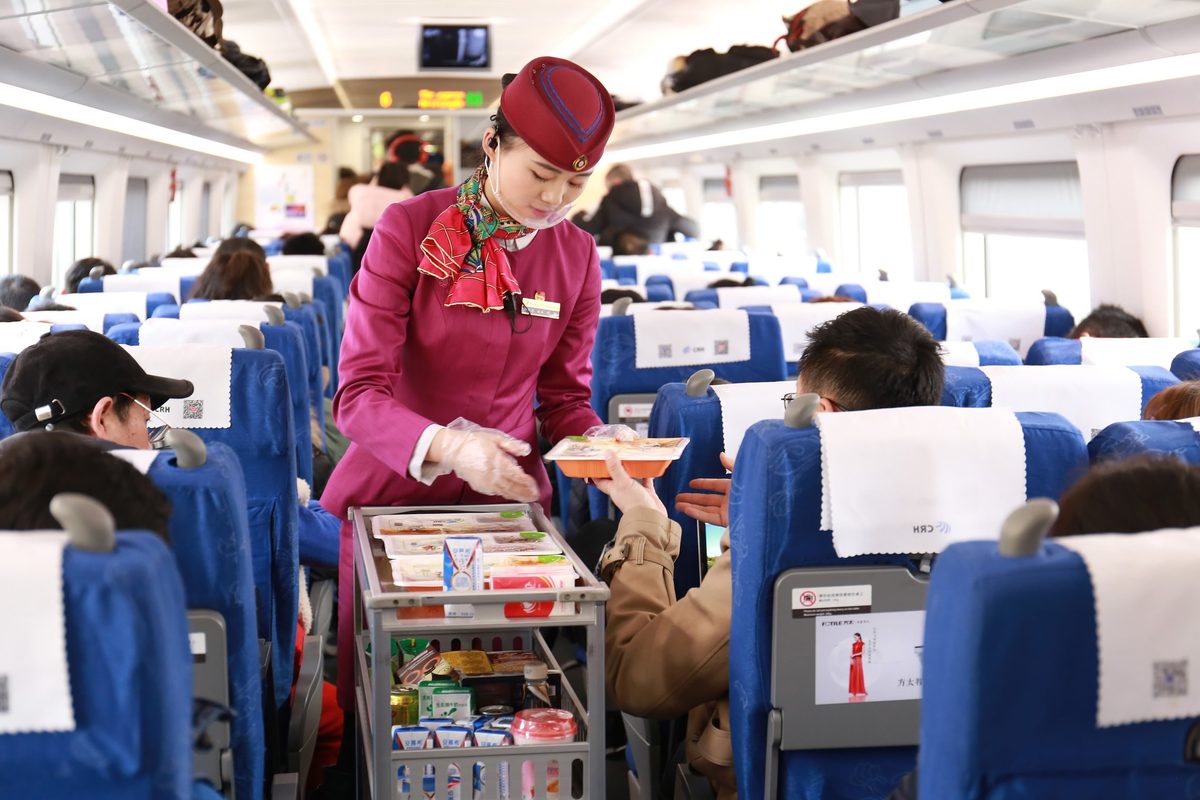 Order restaurant food delivered right to your seat on the train
You can order restaurant food to be delivered to your seat on the train through the 12306 app. It's called 高铁外卖 (gāotiě wàimài). Over 90 high-speed stations offer this service.
How it works:
- 餐饮·特产
- Enter your train number and travel date
- Browse restaurants at upcoming stations (KFC, McDonald's, local favorites)
- Order at least 60 minutes before the train arrives at that station
- Staff deliver the food to your seat when the train stops
Meals typically cost ¥30–60 plus a delivery fee of ¥6–8. Stick with national chains for consistent quality.
How to Read Your Ticket
Station names: Most Chinese cities have multiple train stations named after the city plus a direction — 东 (East), 南 (South), 西 (West), 北 (North). Always double-check which station you need.
Seat information: 08车12D号 means Carriage 8, Seat 12D. For sleeper tickets: 11车017号下铺 means Carriage 11, Berth 17, Lower Sleeper (下铺=lower, 中铺=middle, 上铺=upper).
Boarding the Train: Step by Step
- Arrive 60–90 minutes early for major stations, 45 minutes for smaller ones
- Go through airport-style security (X-ray for bags, metal detector for people)
- Find your gate (检票口) on the electronic departure boards
- Board when your gate opens (~15 min before departure). Use the manual channel (人工通道) for foreign passports
- Find your carriage using colored markers on the platform, then locate your seat
Luggage
Official limit: 20 kg for Second/First Class, 35 kg for Business Class. In practice, staff rarely weigh bags. Storage: overhead racks, large luggage area at carriage ends, and under the seat.
Charging & WiFi
New Fuxing trains: every seat has AC + USB (some with USB-C). Older CRH trains: fewer outlets, shared between rows. Conventional trains: essentially no accessible outlets — bring a power bank.
Don't count on train WiFi — it's slow and unreliable. But 4G/5G mobile coverage is excellent along most high-speed routes. A Chinese SIM or eSIM with data will keep you connected for almost the entire journey.
Bathrooms
Located at both ends of every carriage. Business Class and Soft Sleeper usually have Western-style toilets. High-speed trains are generally clean with toilet paper provided. Conventional trains mostly have squat toilets — bring your own toilet paper and hand sanitizer.
Foreigner-Specific Tips
- Booking with passport: 12306 now supports foreign registration — upload passport photo page, approval usually within minutes
- Payment: 12306 accepts Visa/Mastercard/JCB but foreign card declines are common. Link Alipay/WeChat Pay or use Trip.com as fallback
- Real-name system: ticket is tied to your identity — present the same passport to board
- Manual gate hack: foreign passports often don't work with automatic turnstiles — look for 人工通道 (manual channel)
- Ticket release: exactly 15 days before departure. Popular routes sell out within minutes during holidays
Key Takeaways
China's train system is remarkably straightforward once you know the basics. The 12306 food delivery alone is worth downloading the app for, and the manual boarding channel saves a lot of stress at the station.
Essential reminders:
- Arrive early (60–90 min for major stations)
- Use the manual channel (人工通道) with your passport
- Order food via 12306 高铁外卖 — restaurant-quality meals at your seat
- Bring a power bank for older trains
- Book 15 days ahead for popular routes
Continue reading:
- The Complete Guide to China High-Speed Rail Seat Types →
- China Overnight Trains: Sleeper Types, Tips & What to Expect →
Read our complete 12306 Booking Guide for foreigners →
Need Help Planning Your Trip?
Our local experts can help with tickets, transportation, and more.
Chat on WhatsApp