Healthcare in China: How to See a Doctor as a Foreigner
Everything you need to know about getting medical care in China as a foreign visitor — from finding the right hospital, to understanding public vs. private options, to handling insurance claims.
Where to Get Medical Care in China
Emergency
- Dial the emergency number 120, clearly describe your address, and wait for the ambulance. Note: the 120 line currently does not provide multilingual services.
- Seek medical treatment at the emergency department of the nearest facility. Emergency departments operate 24/7.
If you cannot communicate in Chinese, ask a hotel staff member, a friend, or use a translation app to help describe your symptoms and location to the 120 operator.
Non-Emergency: Public Hospitals
Government-run hospitals are the mainstay of China's medical service system. Grade 3A hospitals (三甲医院, sānjiǎ yīyuàn) are the most authoritative and well-equipped. Some hospitals provide online appointment services — you can log on to the hospital website or download the hospital app to make an appointment.
Some public hospitals have international departments (国际医疗部, guójì yīliáo bù) that provide medical services to foreign nationals, often with English-speaking staff and direct insurance billing.
Non-Emergency: Private Hospitals
Many private hospitals in China offer world-class diagnostic and treatment services with language support. They tend to be more expensive but offer shorter wait times, more comfortable facilities, and better communication for non-Chinese speakers.
Popular options in major cities include United Family Healthcare (和睦家), Raffles Medical, and ParkwayHealth. These chains cater specifically to expats and international visitors.
 Public and private hospitals serve different needs in China
Childbirth
Both public and private hospitals offer childbirth services. Hospitals with the necessary conditions may allow family members to accompany the mother during delivery. Doctors will decide whether a cesarean section is necessary based on the mother's physical condition. Pregnant women usually need to prepare their own pajamas, towels, baby diapers, and other supplies.
Health Check-up
Foreign nationals who have resided in China for one year or more are required to undergo a health check-up. You can visit the official website of the International Travel Health Care Center (国际旅行卫生保健中心) at various locations to obtain information.
Steps for Medical Treatment
Outpatient Procedure (Non-Emergency)
- Register at the hospital (bring your passport)
- Pay the registration fee at the cashier
- Go to the relevant department and wait for your number to be called
- See the doctor — describe your symptoms
- If tests are needed, pay and go to the testing department
- Return to the doctor with test results for diagnosis
- If medication is prescribed, pay at the cashier and collect at the pharmacy
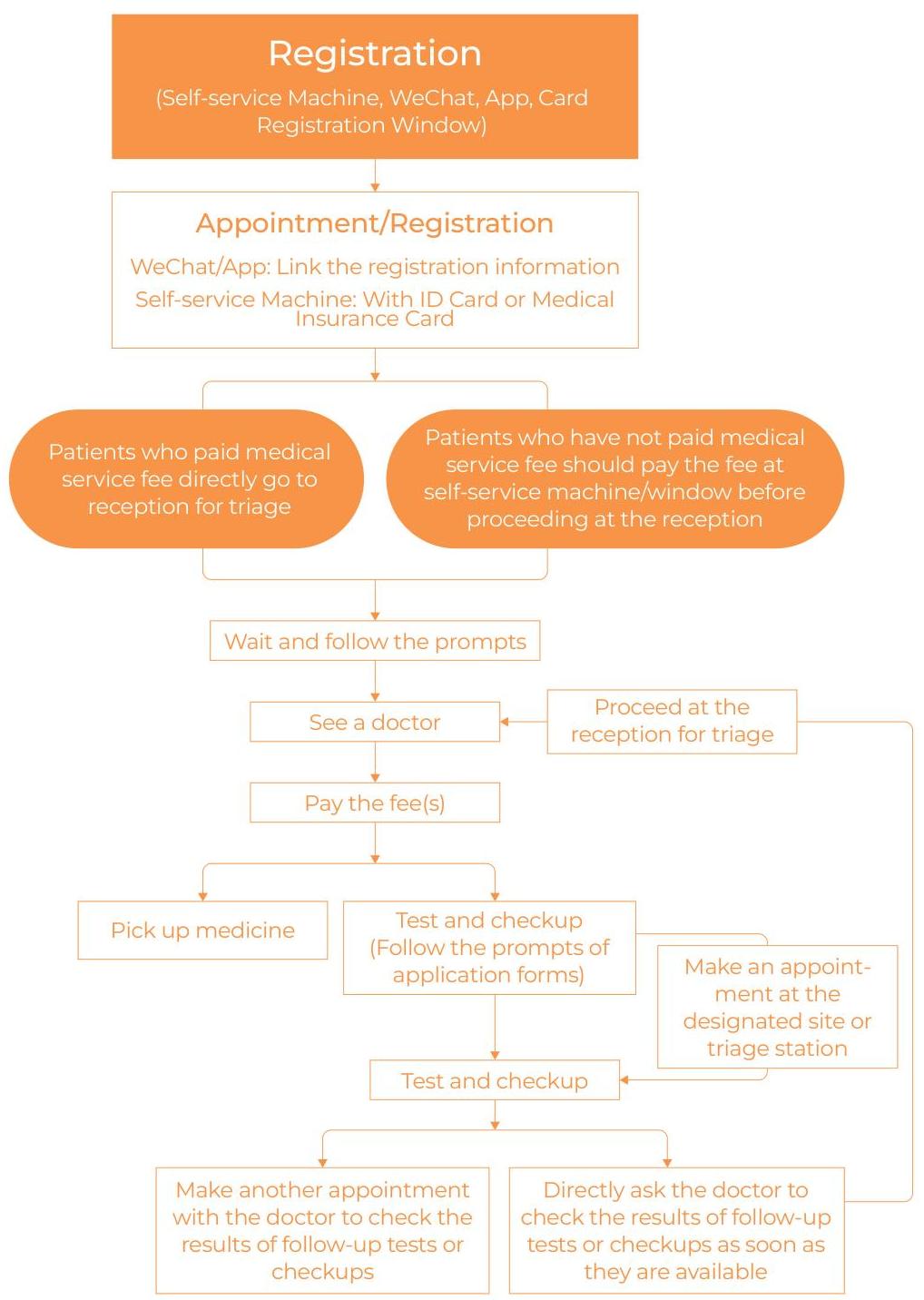 Step-by-step outpatient procedure at a Chinese hospital
Emergency Procedure
- Go directly to the emergency department (急诊, jízhěn)
- Triage nurse assesses your condition
- Emergency treatment begins immediately
- Registration and payment can be handled after treatment
- If hospitalization is needed, the hospital will guide you through the process
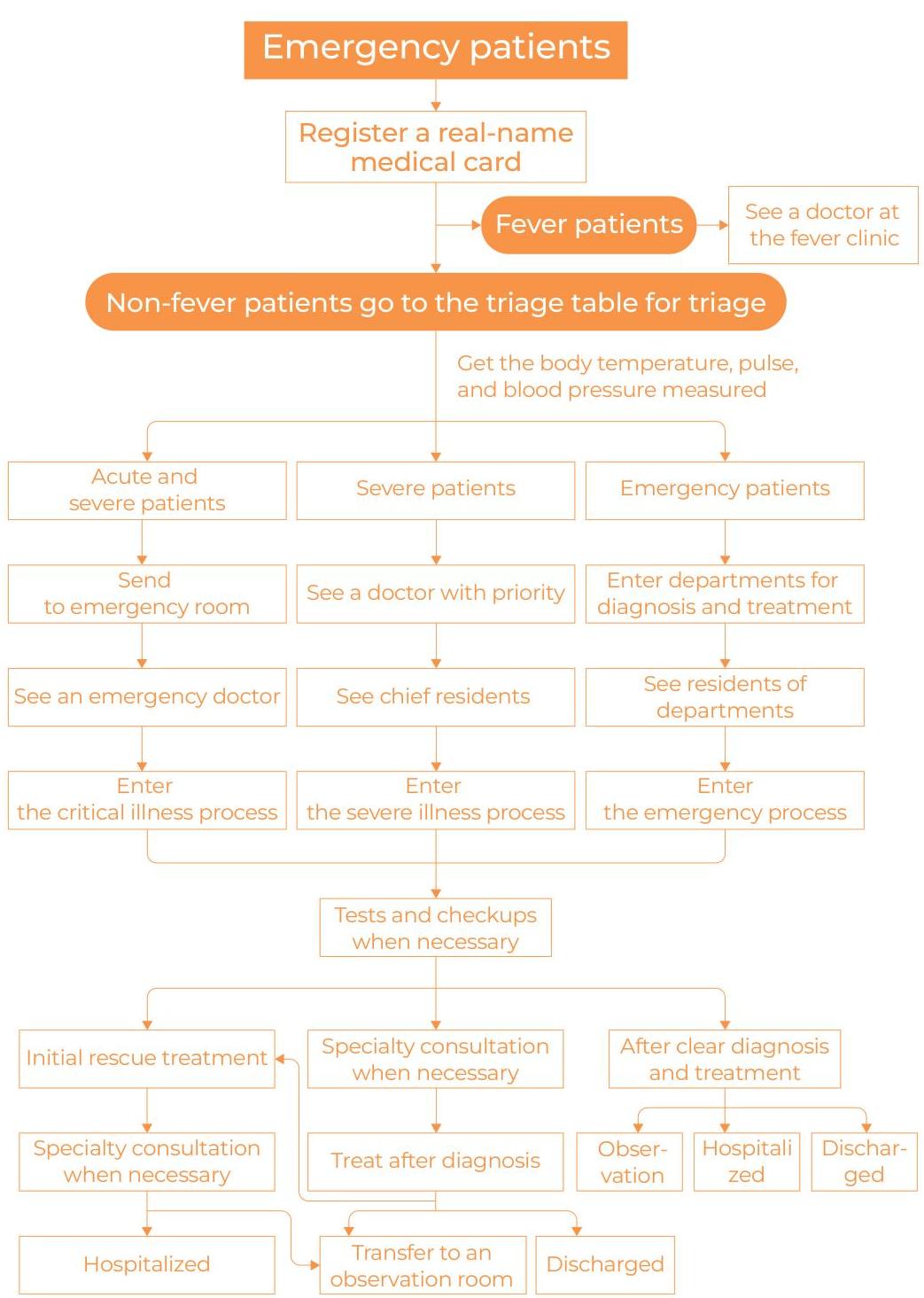 Emergency department procedure flow
How to Make an Appointment
Before visiting a private hospital, international medical department, or special outpatient department, it is recommended to make an appointment first. Three common methods:
- Log on to WeChat or Alipay app, or download the hospital's official app (some have English interfaces) and make an appointment online.
- Call the hospital's dedicated appointment number.
- Visit the hospital's outpatient building and use the manual service counter or self-service registration machine.
After making an appointment, arrive at the hospital at your scheduled time. Medical staff will guide you through subsequent procedures.
[!TIP] Bring your passport to every medical visit. It is required for registration at most hospitals.
 How to make a hospital appointment in China
Medical Insurance in China
Employee Basic Medical Insurance
According to the Interim Measures for Social Insurance System Coverage of Foreigners Working within the Territory of China, employers who hire foreigners must process social insurance registration within 30 days of issuing employment permits.
Foreign nationals participating in the employee basic medical insurance can present their medical insurance card or electronic medical insurance certificate when settling medical expenses at designated medical institutions.
Commercial Insurance
Many foreign nationals choose to purchase medical insurance, and sometimes employers provide medical insurance as part of their employee benefits. You can choose to purchase medical insurance from local or foreign insurance companies.
Important notes:
- Some public hospitals in China do not recognize medical insurance from foreign insurance companies.
- When signing a contract with an insurance company, confirm which hospitals are covered and what conditions are included.
- Always ask for a payment invoice (发票, fāpiào) so you can claim reimbursement from the insurance company later.
 Medical insurance options for foreigners in China
Commercial Insurance Claims
When applying for a claim, the information that needs to be submitted usually includes:
- Outpatient and inpatient medical records
- Detailed expense lists
- Medical expense invoices (发票)
- Diagnosis certificates
- Examination and test reports
Please refer to your insurance company's requirements for specific details. If the insurance company finds any part beyond the claim scope, they will contact you to resolve the issue.
 Steps for filing a commercial insurance claim in China
Useful Chinese Phrases for Medical Visits
Knowing a few key phrases can make your medical visit much smoother:
| English | Chinese | Pinyin |
|---|
Buying Medicine at a Pharmacy
Pharmacies (药店, yàodiàn) are common throughout Chinese cities. Many over-the-counter medicines are available without a prescription. Common pharmacy chains include Tongrentang (同仁堂), Watsons Pharmacy, and Nepstar (海王星辰).
- Bring your passport — some pharmacies require ID for certain medications.
- Show the pharmacist your symptoms using a translation app if needed.
- Antibiotics generally require a prescription in China.
- Traditional Chinese Medicine (TCM) pharmacies are widely available and can be a complement to Western medicine.
Need Help Finding a Doctor?
If you're in China and need help finding an English-speaking doctor, navigating the hospital system, or dealing with insurance paperwork, our local team can assist. We can help you find the right hospital, make appointments, and handle translation.
Need Help Planning Your Trip?
Our local experts can help with tickets, transportation, and more.
Chat on WhatsApp